
Paris, France —Balance and the loss thereof, existentialism, a hand and a room of one’s own are all highlights of an exhibition being played out at the Institut Giacometti in the heart of the Montparnasse neighbourhood of Paris. The show revolves around the friendship of three key figures of the 20th century artistic and cultural landscape: Simone de Beauvoir, Jean-Paul Sartre and Alberto Giacometti. Entitled Beauvoir, Sartre, Giacometti. Vertiginousness of the Absolute, it explores the strong bonds bringing together these famous writers, philosophers and artist. The approach is at once philosphical, literary and artistic and takes a look at the quest for the absolute in art, thought and life itself. It also offers an inside glimpse into how these artists lived.

Back in 1944 or 1945 Giacometti experienced a hallucinatory episode concerning the sensation of depth as he left a cinema on the boulevard Montparnasse. In her memoirs (The Prime of Life), de Beauvoir who lived up the street from him and saw him on almost a daily basis remembers, « For a long period, when he walked down the streets, he had to touch the solidity of the walls with his hand to resist the chasm opening next to him. » She likened it to the ptractice of writing and creating when losing one’s grip on the imaginary could lead to extreme perceptions. It was during this period that Giacometti created two of the sculptures that are the stars of the show, Falling Man and The Hand, both dating from 1950.

The show also offers a re-creation of de Beauvoir’s living and work room, photographs of the friends together, writings and publications by Sartre as well as contemporary photographs by Agnes Geoffroy representing emptiness and loss of balance, commissioned for the exhibition. The de Beauvoir writing room is described as a Room of Her Own, in a nod to the Virginia Wolf essay about the necessity for a writing room of one’s own.

« My way of life had changed. I stayed at home a lot. That word had acquired a new meaning. For a long time, I possessed nothing, no furniture, no wardrobe. Now there was in my wardrobe, jackets and skirts from Guatemala, Mexican blouses, a suit and coat from the USA. My room was decorated with worthless objects, but precious in my eyes: ostrich eggs from the Sahara, tom-toms, drums Sartre had brought back from Haiti, glass swords and Venetian mirrors he had purchased on rue Bonaparte, a plaster mould of his hands, Giacometti’s floor lamps. I enjoyed working in front of the window: the blue sky framed by red curtains, resembled a décor by Bérard, » de Beauvoir wrote in Force of Circumstance.
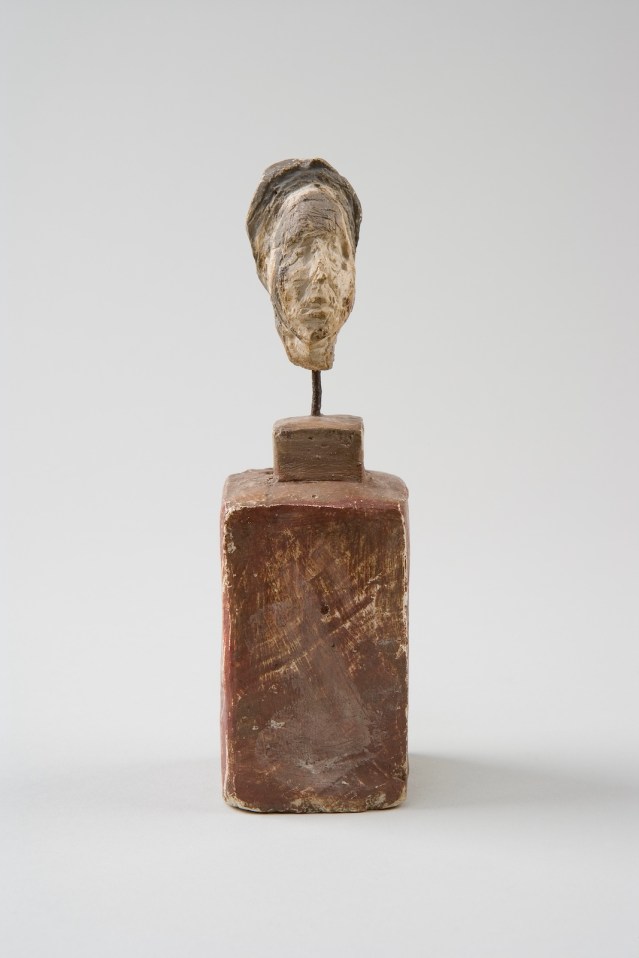
The Institut Giacometti regularly brings to life its extensive collections. The Simone de Beauvoir and Jean-Paul Sartre show comes to a close on October 12th and will be followed by a show juxtaposing Giacometti’s works with those of the Syrian artist Marwan opening up on October 21st. Both artists repeatedly represented the head in their works. The Institut Giacometti is part of the Fondation Giacometti devoted to exhibitions and research in art history and pedagogy. Alberto Giacometti’s mythical studio, whose elements in their entirety, had been kept by his widow, Annette Giacometti, is on permanent display at the Institute. Conferences, workshops and guided tours are all on the agenda with guided visits in English on Saturdays at 11am. The current exhibition is accompanied by a richly illustrated catalogue in a bilingual French/English edition. The Institute, which has an eclectic program of performances and conferences, is open Tuesdays to Sundays, from 11am until 6pm. https://www.fondation-giacometti.fr/en 5 rue Victor-Schoelcher, 75014 Paris, France, +33 (0)1 44 54 52 44. ©Trish Valicenti for The Gourmet Gazette
Discover more from The Gourmet Gazette
Subscribe to get the latest posts sent to your email.
Categories: Gourmet Fair
 The Gourmet Gazette