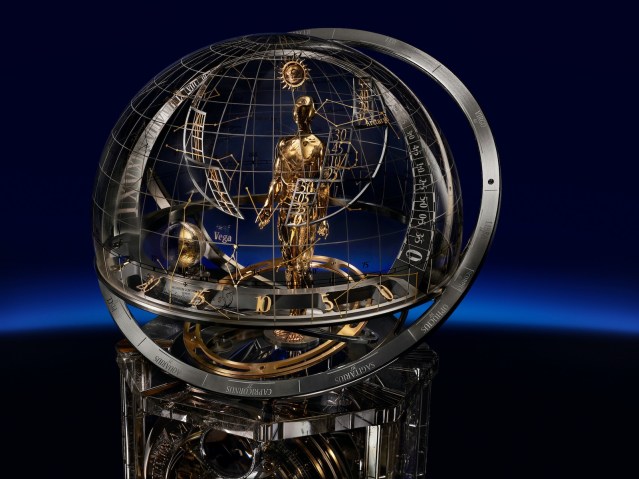
Marcel Proust went in search of time, lost time that was shrouded in his memories in his 7-volume masterpiece Remembrance of Things Past, known more recently as In Search of Lost Time. Measuring time, seeking time, living time, stopping time is a pre-occupation for some, a leisure pursuit for others and a work of art and precision for the finest clock and watch makers on the planet. Operating continuously since 1755, the Swiss house of Vacheron Constantin is regarded as the world’s oldest watch manufacture. Celebrating its 270th anniversary this year, the house continues to create unique timepieces through its generations of master craftsmen. To celebrate, the house has bought out an exceptional astronomical clock that combines a timekeeping instrument with the arts and crafts of high watchmaking and the keen kinetic movement of automatons. Entitled La Quête du Temps (The Quest for Time), it is clearly a masterpiece. A masterpiece that goes beyond watchmaking.
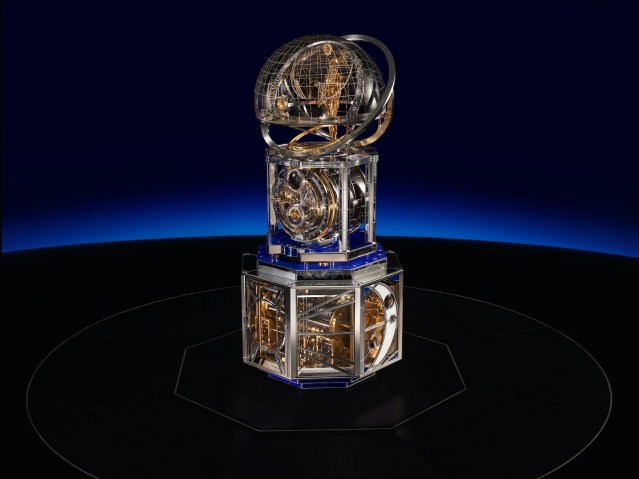
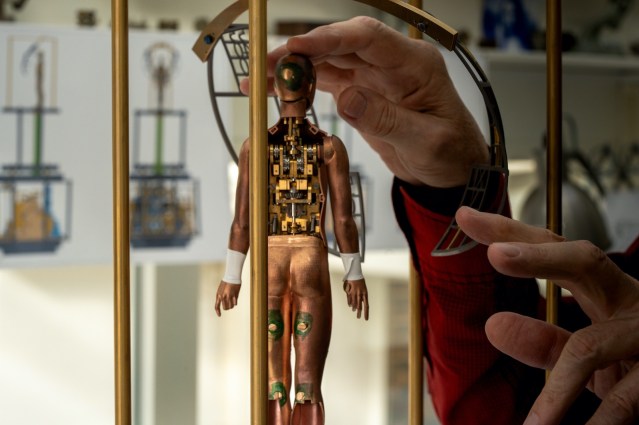
Composed of intricate dials and mechanisms, astronomical clocks more closely resemble highly detailed works of art rather than timepieces. Dating back to the 15th century, these clocks display time, and information about the sun, moon, and constellations—some even showcase the movement of the planets. Astronomical clocks are not only scientific marvels, but are also detailed works of precision, engineering, art, craft and design. This is animated time at its best. At the heart of the automaton is the Astronomer, somewhat akin to Proust’s Narrator in Remembrance of Things Past, during which the Narrator explores the passage of time. The Quest for Time astronomical clock takes us into the present flow of time while bringing together myriad precious materials to dream upon: rock crystal, anthracite, old-mine lapus lazuli, quartzite, mother-of-pearl, 18K yellow gold, red jasper, azurite and of course diamonds.
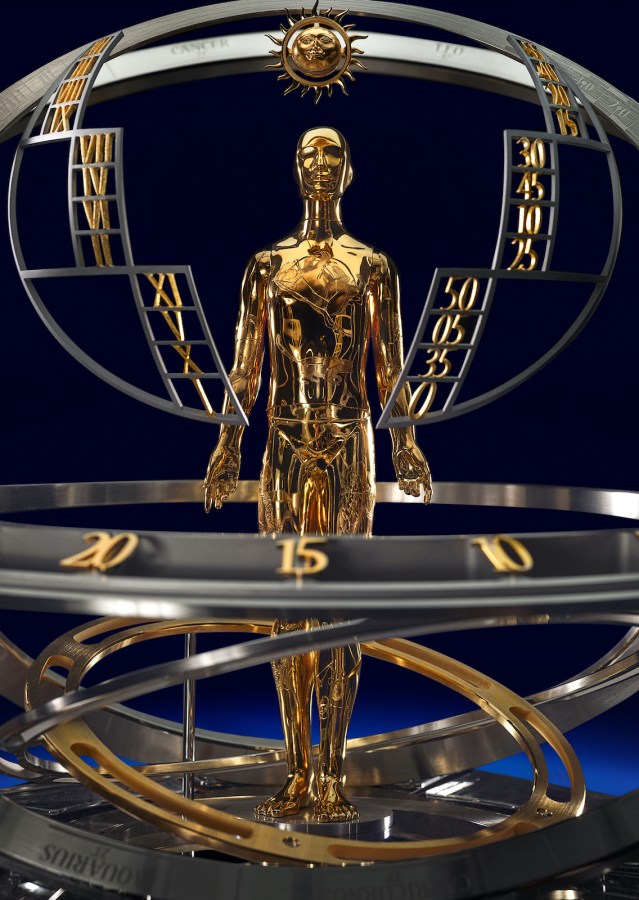
The Astronomer is positioned beneath a glass dome decorated with a celestial vault and a golden sun. A three-dimensional retrograde moon is set on a flat, semi-circular plane in front; and day and night are depicted at the automaton’s feet. The glass dome is painted with a representation of the celestial vault in the Northern Hemisphere, and depicts the constellations and Zodiac signs of Leo, Taurus, Gemini, Virgo and Libra. The constellations are positioned as they would have appeared in the sky above Geneva on the day that Vacheron Constantin was founded: 17 September 1755. To determine the precise position of each constellation and star at 10.00 am, the time that Jean-Marc Vacheron signed the contract to employ his first apprentice, Vacheron Constantin worked with astronomers from the Geneva Observatory in Versoix, Switzerland, recognized as one of Europe’s most important observatories.
Meanwhile, the central section of La Quête du Temps, The Quest for Time, is dominated by the astronomical clock, with its signature complications and two dials. The central section of La Quête du Temps is dominated by the astronomical clock, with its signature complications and two dials. It features Vacheron Constantin’s signature Maltese Cross-shaped cage. A circle of baguette-cut diamonds surrounds the tourbillon aperture, highlighting the mechanical ballet playing out within. The reverse-side dial depicts a Northern Hemisphere celestial vault that tracks the movement of the constellations in real time, and so also measuring the sidereal day. Because it takes Earth less time to rotate once relative to the stars than to rotate once relative to the Sun, the sidereal day is approximately four minutes shorter than the 24-hour calendar day that defines civic time.
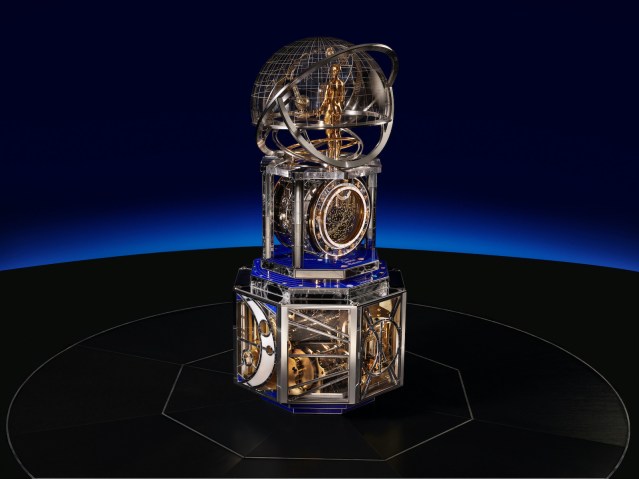
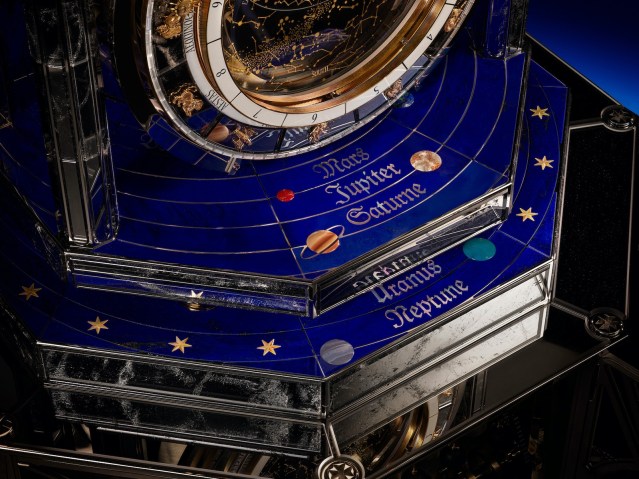
The base of the masterpiece is particularly eye-catching. Beneath the clock, a two-level plinth depicts the solar system against a background of lapis lazuli. The planets are represented by cabochons of ornamental hard stones and their names are formed by mother-of-pearl inlays. Below that, the octagonal base of the structure houses the mechanism that drives the automaton’s movement and creates the music that plays during the animation. Clad in rock crystal, lapis lazuli and quartzite, it is decorated with a geometric motif starting with the sun at the front and ending with a moon at the back.
“Is it always possible to do better? Is it always possible to be amazed? Undeniably.” comments Laurent Perves, CEO of Vacheron Constantin. “At Vacheron Constantin, the pride and emotion we feel with each new project comes from the freedom and passion to create, which is fuelled by the quest for excellence and innovation. The result of seven years of work, this unparalleled collaborative project has given life to a marvellous object, a mécanique d’art that brings together mankind and the universe, in an unprecedented cultural and artistic statement. It also inspired, as is always the case at Vacheron Constantin, a Métiers d’Art wristwatch like no other.”
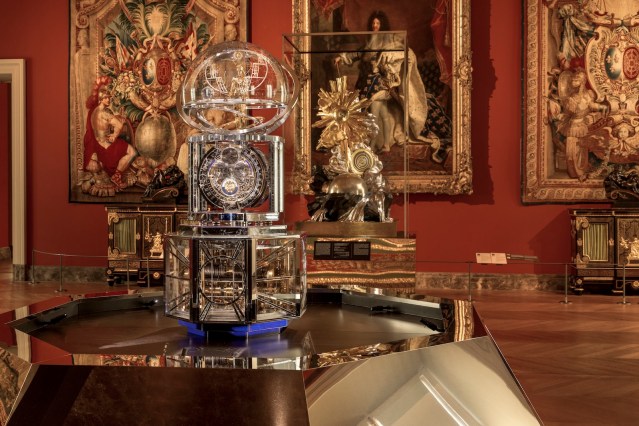
The Quest for Time from Vacheron Constantin required seven years of development, 6,293 mechanical components, 1,020 decorative components and 23 watchmaking complications. And it appears to capture the spirit and quest of François Constantin who remarked in 1819, « do better if possible, and that is always possible.» Within the context of Vacheron Constantin’s partnership with the Louvre museum in Paris, La Quête du Temps was unveiled as the centrepiece of the “Mécaniques d’Art” exhibition at the museum, held in Paris from 17 September to 12 November 2025. ©Trish Valicenti for The Gourmet Gazette
https://www.vacheron-constantin.com/fr/en/home.html
Discover more from The Gourmet Gazette
Subscribe to get the latest posts sent to your email.
Categories: Gourmet Time Wear, Gourmet Ware
 The Gourmet Gazette