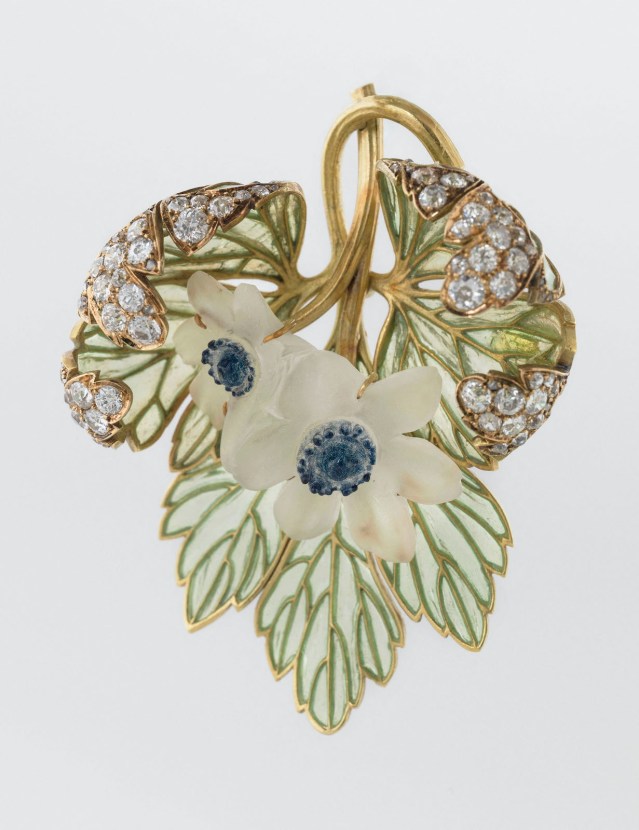
Paris, France — There are swans and water lilies, Egyptian scarabs, butterflies and sycomores alongside fabulous fuschias, the famous chimeras of Cartier and René Lalique’s wood anemone. As the high jewellery houses in Paris present their new collections in Paris this week, an intriguing exhibition is being played out at the Petit Palais museum offering an insight into the genesis of high jewellery making and one of its sources: drawings. Entitled Jewellery Designs. Secrets of the Creation, the show reveals the diversity and breadth of the Petite Palais’s collection of drawings of jewellery designs, spanning over a century of creation, from the second half of the 19th to the mid-20th century.
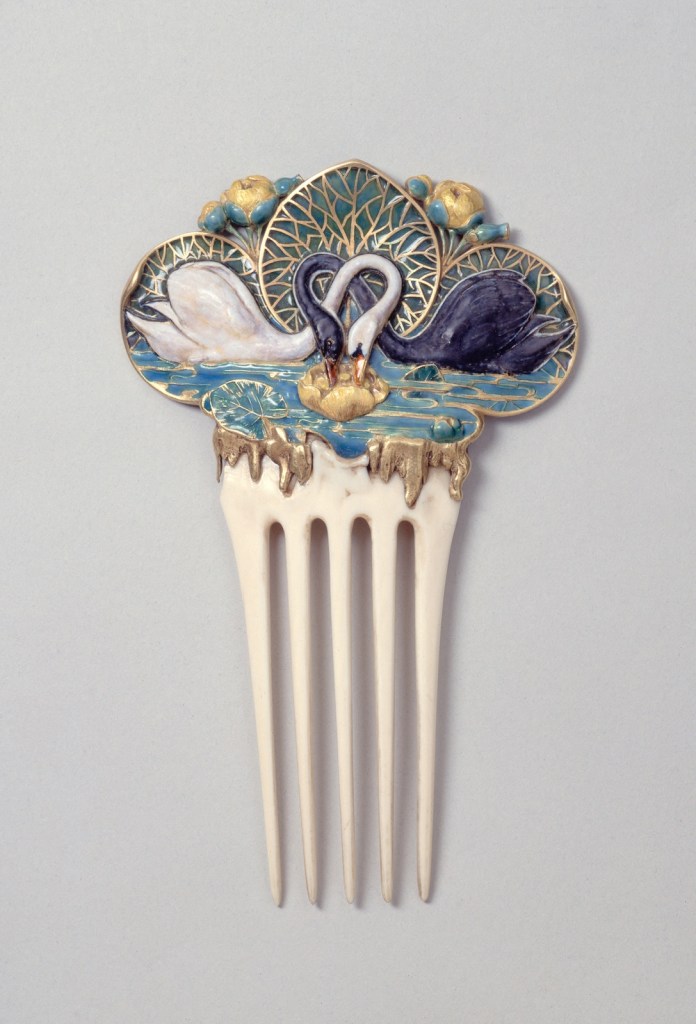

Left: Vever Frères, based on a design by Eugène Grasset, Swans and Water Lilies comb, circa 1900. Ivory, repoussé gold, translucent and opaque enamel, 15.5 × 9.5 × 0.5 cm. Petit Palais, Musée des Beaux- Arts de la Ville de Paris. Gift of Henri Vever, June 1925. ©Paris Musées/Petit Palais, Musée des Beaux- Arts de la Ville de Paris. Photo courtesy Petit Palais. Handout via The Gourmet Gazette. Right: Georges Callot, Drawing for the Swans and Water Lilies comb, circa 1900.Black ink, tracing paper, gouache, graphite pencil, 23 × 14.8 cm. Petit Palais, Musée des Beaux-Arts de la Ville de Paris. Purchase, 1987. ©Paris Musée /Petit Palais, Musée des Beaux-Arts de la Ville de Paris. Photo courtesy Petit Palais. Handout via The Gourmet Gazette
Through a remarkable selection of designs from a collection comprising over 5,500 works, this exhibition showcases the wealth of a collection amassed since the late 1990s and preserved in the museum’s reserves, away from the public spotlight and more importantly from light for drawings are fragile works of art that with too much light can fade away. Featuring drawings by designers like Pierre-Georges Deraisme and Charles Jacqueau, as well as those by prestigious jewellery houses such as Boucheron, Cartier, Lalique, Rouvenat, and Vever, this exhibition showcases the evolution of styles and techniques in the field of jewellery.


Left: Unidentified designer, for Cartier Paris, Chimera”bracelet, 1928. Graphite pencil, ink and gouache on translucent wove paper. Cartier Archives, Paris. ©Cartier. Photo courtesy Petit Palais. Handout via The Gourmet Gazette. Cartier Paris, Rigid Chimera bracelet, 1928. Gold, platinum, enamel, sculpted coral, sapphires, diamonds, emeralds, 7.4 × 8.15 × 1.60 cm. Cartier Collection. Nils Herrmann, Cartier Collection ©Cartier. ©Paris Musées/Petit Palais, musée des Beaux-Arts de la Ville de Paris. Photo courtesy Petit Palais. Handout via The Gourmet Gazette
It is a journey into the imaginary universe of jewellery designers who draw their inspiration directly from the observation of nature, as well as collections of ornaments representing decorative forms from different epochs and regions of the world. Sketchpads, plates of motifs, and books all transport the visitor to a range of highly imaginative repertoires. As do the actual jewels themselves, often juxtaposed with the drawings behind them. It is a dialogue between paper and precious metals and materials.

A selection of jewellery from the Petit Palais Collections closes the exhibition. These rarely exhibited parures or sets, presented alongside portraits of elegant women, allow visitors to continue their discovery of this fascinating and sparkling world. The jewellery exhibition in on until July 20th but the museum is in and of itself worthy of a visit. Built for the Exposition Universelle of 1900, the Petit Palais building is a masterpiece by architect Charles Girault. In 1902, it became the City of Paris Museum of Fine Arts and presents a very beautiful collection of paintings, sculptures, furnishings and art objects dating from Antiquity to 1914.Admission to the permanent collections is free of charge. ©Trish Valicenti for The Gourmet Gazette
PETIT PALAIS – MUSÉE DES BEAUX-ARTS DE LA VILLE DE PARIS, Avenue Winston-Churchill, 75008 Paris, France. Tel: +33 (0)1 53 43 40 00. petitpalais.paris.en
Discover more from The Gourmet Gazette
Subscribe to get the latest posts sent to your email.
Categories: Gourmet Fair, Gourmet Ware, Gourmet Wear
 The Gourmet Gazette