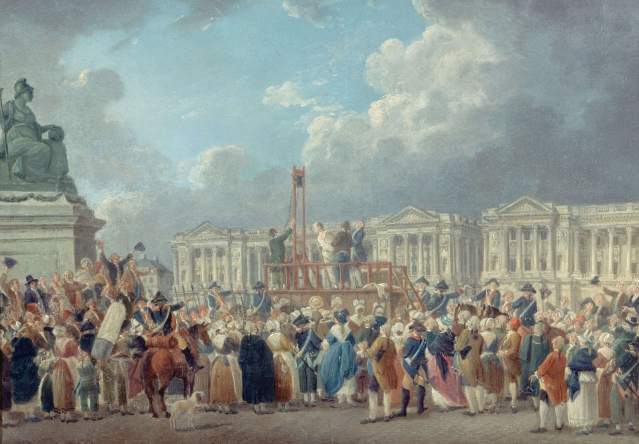
Paris, France — A bathtub killing, the beheading of the last queen of France, guillotining galore. It was a time of retribution with public executions decidedly on trend often accompanied by lavish public parties. Robespierre and Charlotte Corday were among the names of the day. The Cathedral of Notre Dame was re-named the Temple of Reason. Sixteen Carmelite nuns from the city of Compiègne were executed in Paris, beatified by Pope Pius X in 1909 while process for canonization is currently underway. After the glorious Storming of the Bastille and the Declaration of the Rights of Man and of the Citizen in 1889, Paris became the capital of the Enlightenment and Revolutions, down came the terror just a few four short years later. It was The Reign of Terror or La Terreur in French which sounds even more terrifying and terrorizing. It was 1793 for the rest of the world but the Year II of the republican calendar which covered the period from September 22nd, 1793 to September 21st 1794 in France. It was a key year for the French Revolution.

While 1789 offered a brightness, 1793 became darker and as it was coming to an end in 1794 it had already earned a name Terror. Fabricated for political reasons, the word indicates the authoritarian transition that the republican regime had undergone. Yet, the years 1793-1794 are also the years that some, confident in their ability to reinvent history, called “Year II”: a year defined by its breaking with the past and its revitalizing of revolutionary utopias. It is a contrasted legacy, one that is being explored in an exhibition at the Musée Carnavalet- Histoire de Paris, the museum of the history of Paris, entitled Paris 1793-1794: A Revolutionary Year. The museum is renowned around the world for its collections of the French Revolution and is singling out one year of the revolution, regarded as the most complex of them.

The year 1793-1794 was “revolutionary” in two senses of the word: a part of the 700,000 Parisians experienced it as a time of utopia and political experiments that might thwart despair, but it was also “revolutionary” because of the exceptional and provisional measures that weighed heavily on the population like collective fears and state violence alongside extraordinary daily activities, executions, feasts, and celebrations. Wild rumors, too, were prolific, the fake news of the period. The exhibition brings together more than 250 works of all kinds: paintings, sculptures, objects of decorative arts, historical and memorial objects, wallpaper, posters, pieces of furniture underscoring collective histories and incredible individual fates. One of the more macabre objects on display is a guillotine blade.

Among those fates was that of the journalist and representative to the Assembly governing revolutionary France Jean-Paul Marat who was famously assassinated in his bathtub by another revolutionary Charlotte Corday wielding a kitchen knife who in turn would be guillotined as was one of the most infamous actors in the French Revolution, Robespierre. Olympe de Gouges whose Declaration of the Rights of Women and of the Female Citizen is world renowned today would be executed on November 3rd, 1793. After being imprisoned in the Conciergerie for 76 days Marie-Antoinette would be tried and guillotined on October 16th, 1793. On another royal note the heir to the throne of France, the Dauphin Louis Charles also known as Louis XVII, died in prison at the age of 10 on June 8th, 1795. His jailer, the shoemaker Antoine Simon, would become the archetype of cruelty. But in this same Reign of Terror free public schools were opened and obligatory for boys and girls who were taught by both men and women teachers and Paris remained the capital of theatrical and lyrical creation.
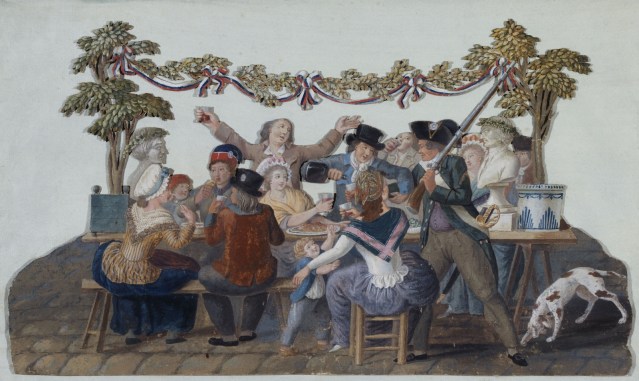
The French Revolution exhibition is on until February 16th but the museum’s permanent collections are worth a visit to learn about Paris from prehistorical times to the present. The permanent collection is free of charge. ©Trish Valicenti for The Gourmet Gazette
Musée Carnavalet – Histoire de Paris,23 rue de Sévigné, 75003 Paris, France. http://www.carnavalet.paris.fr/en
Discover more from The Gourmet Gazette
Subscribe to get the latest posts sent to your email.
Categories: Gourmet Fair
 The Gourmet Gazette