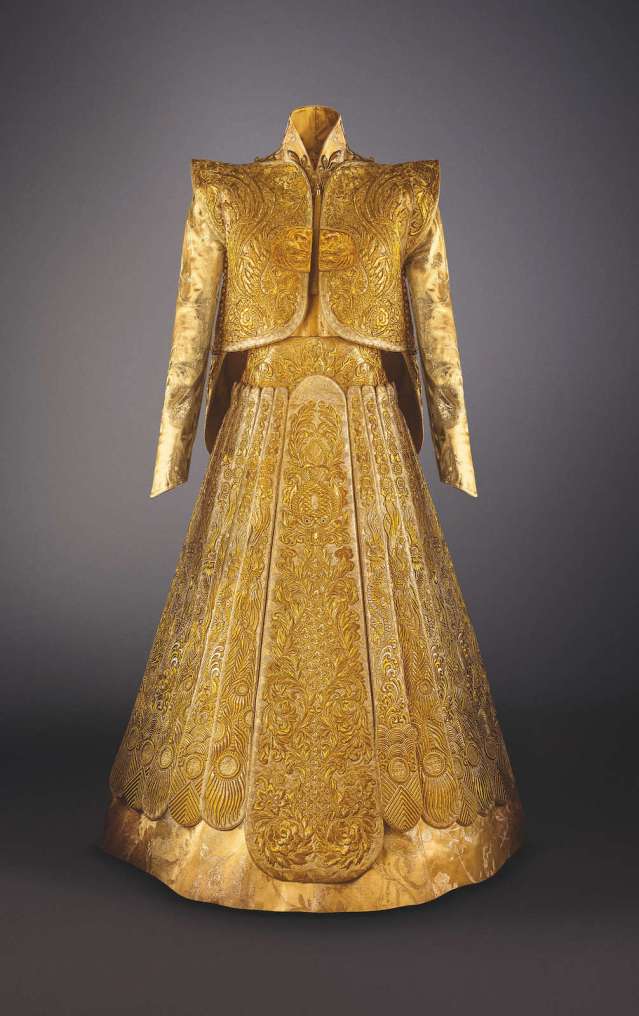
Paris, France —As Men’s Fashion Week draws to a close and with the French capital gearing up for the couture collections in one week’s time, an exhibition currently underway in Paris demonstrates that one thing never goes out of style: gold. The show, entitled Gold Thread. The Art of Dressing from North Africa to the Far East, is being held at the Musée du Quai Branly-Jacques Chirac and showcases the thousand-year history of gold in the textile arts. It offers a fascinating story of artistic creation, traditional expertise and technical invention. A story that continues to this day.
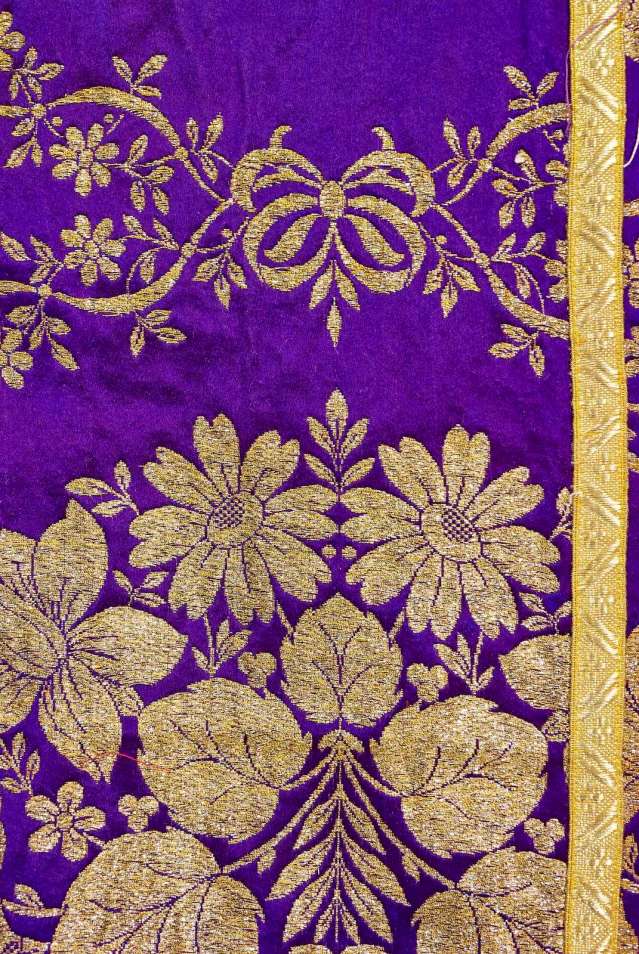
As early as the fifth millennium B.C., gold was used to embellish the first luxury fabrics for men of power. Over the centuries that followed, skilled weavers and craftsmen – Roman, Byzantine, Chinese, Persian and then Muslim – used the most ingenious techniques to create veritable fabrics of art where silk or linen fibres were intertwined with golden threads and lamé. Outfits like coats (caftans), tunics, trousers, and waistcoats point to the cultural melting pot that characterizes the Maghreb countries (Morocco, Algeria, Tunisia). This region was characterised by a taste for splendour from very early on. In the 10th century, the town of Mahdia in Tunisia was famous for its fabrics woven with golden threads and silk. Two centuries later, under the Almohad dynasty, golden brocade silks were produced in the workshops in Marrakesh, Morocco, as well as in Malaga and Almeria in Andalusia.

But the taste for luxurious and richly ornamented clothing would spread beyond North Africa into Ottomann Turkey, Iran and the Arabian peninsula where ceremonial gowns were trimmed with gold thread and lamé. The march of gold in fashion didn’t stop then and there either. For extravagant weddings, Indian women choose gold and drape themselves in the most sumptuous brocade saris embroidered with golden metallic threads. In Malaysia and Sumatra in Indonesia, songket, which are long rectangles of silk woven with gold, are the attire of choice for traditional ceremonies.

Meanwhile in Cambodia and Laos, gold is mainly used to dress members of the royal court, as well as court dancers and theatrical performers, whose glittering costumes, embroidered and woven with gold thread, evoke the deities of the Buddhist and Hindu pantheons. In China, the earliest gold-embellished silks date back to the Han and Jin dynasties (206 B.C. to 420 A.D.). Japan is on the gold agenda as well. From the first half of the Edo period (1603-1867), kimonos were covered with rich gold embroidery and gold-leaf motifs.

Gold dresses from France’s high fashion or couture world are on display as well. This unique exhibition was designed in close collaboration with the Chinese fashion designer Guo Pei, whose 5 new pieces and 9 current outfits punctuate the exhibition, interacting with and enhancing the textile works on display. The exhibition is on until July 6th and a richly illustrated catalogue recounting the story of gold in fashion is available in the boutique. Musée du quai Branly – Jacques Chirac, 37 quai Branly, 218 et 206 rue de l’Université 75007 Paris, France. Tel: +33 (0)1 56 61 70 00. https://www.quaibranly.fr/en/
Discover more from The Gourmet Gazette
Subscribe to get the latest posts sent to your email.
Categories: Gourmet Fair, Gourmet Wear
 The Gourmet Gazette