
Paris, France — While the 16th Conference of Parties (COP16) to the United Nations’ Convention on Biological Diversity did not reach an agreement to ramp up a game plan and spending to protect the diverse species of our world, scientists are still out there making discoveries of new species in the wild and taking on new missions to boldly go into corners of the world to locate, identify and describe new species The fourth Tropical Autumn being held in the greenhouses of France’s National Natural History Museum – Muséum national d’Histoire naturelle (MNHN), is celebrating the diversity of the world’s fauna while showcasing one of the unsung heroes of conservation: the botanical drawer. While the expeditions led by Cook, Humboldt and Darwin among others widely opened the door onto the biodiversity on our planet, work remains for the research community and each year new species are discovered around the world. And while technologies key to science continue to evolve, one thing has remained the same the botanical drawing is essential in describing a new species.
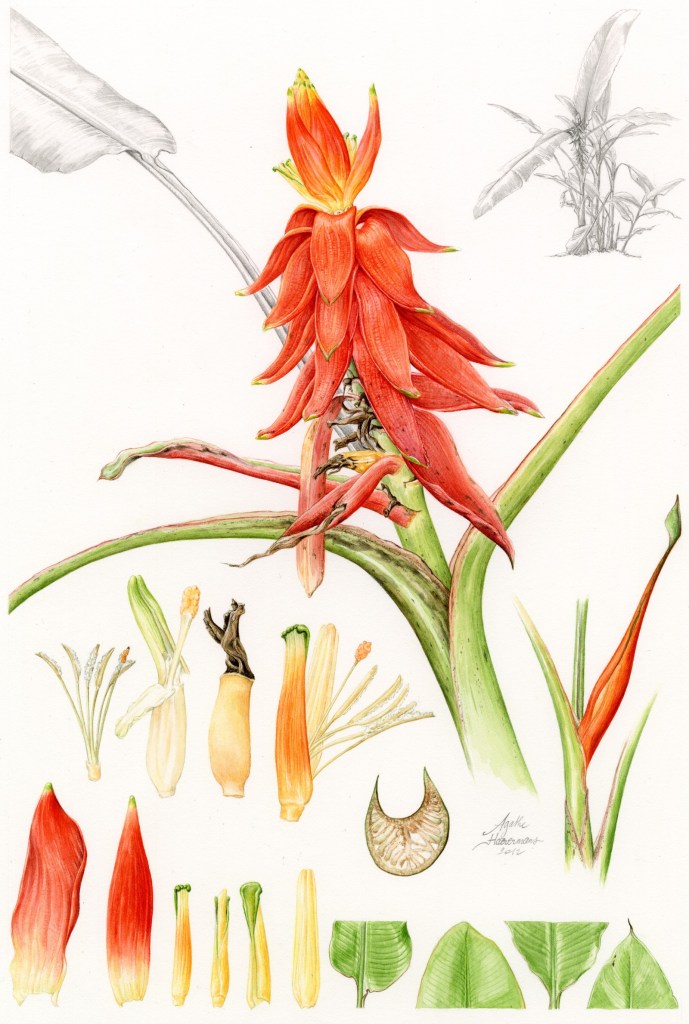
The lofty glass house dedicated to tropical flora dating from 1930 is offering the visitor a discovery of botanical illustrations revolving around three themes: the current discovery of new species, the history of botanical science and art. While historical figures of the natural world are discovered along the way like Carl von Linné and Father Charles Plumier, the monk botanist, the exhibition explores five examples of contemporary expeditions by international teams. The journey through the steamy tropical plant-filled greenhouse, criss-crossed by streams and pathways, is punctuated with the exceptional drawings of exceptional plants and flowers by Agathe Haevermans, as well as her scientific illustrations. Each illustration was made by the scientific illustrator who was on board for some of the missions. Illustrators have accompanied botanists and explorers since the 17th century often working in difficult and dangerous situations to record in great detail the exotic plants encountered along the way. Even photography has not been able to replace the detail of the drawing.

While pictorial representations of plants can be found in works from Antiquity, and while plants and flowers have been key subjects in art throughout the ages, it was only in the 20th century that botanical illustration became an artistic pictorial genre in it own right. What distinguishes a botanical illustration from an art work is the scientific text that accompanies it. Agathe Haevermans began her career at the Muséum national d’Histoire naturelle in 1993 as a zookeeper specialized in caring for reptiles. She became a scientific illustrator in 1999 and in 2011 she created the Société Française d’Illustration Botanique (The French Society for Scientific Illustration). The exhibition is on until November 25th but the museum’s four greenhouses are worth a visit in and themselves. ©Trish Valicenti for The Gourmet Gazette. https://www.mnhn.fr/en 57 rue Cuvier, 75005 Paris, France
See also: https://thegourmetgazette.com/2024/11/02/on-saving-species/
Discover more from The Gourmet Gazette
Subscribe to get the latest posts sent to your email.
Categories: Gourmet Fair
 The Gourmet Gazette
1 reply »