
Bourg-en-Bresse, France — Here soothsayers, astrologers, Sibyls, oracles, seers, card readers, psychics, prophetesses and prophets all bearing promising predictions come together. Seeing into the future has been and remains a pastime of mankind which harbors a fascination for wanting to know what will happen next. Predicting the future has also been a central theme in myriad works of art, underscored by an ambitious exhibition currently underway in the small French city of Bourg-en-Bresse. The exhibition, entitled Predictions, Artists Confronting the Future, is being played out in the Royal Monastery of Brou, a flamboyant Gothic masterpiece, and features works by Dürer, Gustave Doré, Rodin, Chagall and Fujita among others, all exploring various ways of predicting the future. The show continues on at a second venue, the city’s H2M Espace d’art contemporain, a venue devoted to Contemporary Art and the whole show will move to the Musée Thomas Henry in Cherbourg-en-Cotentin in Normandy on July 12th.
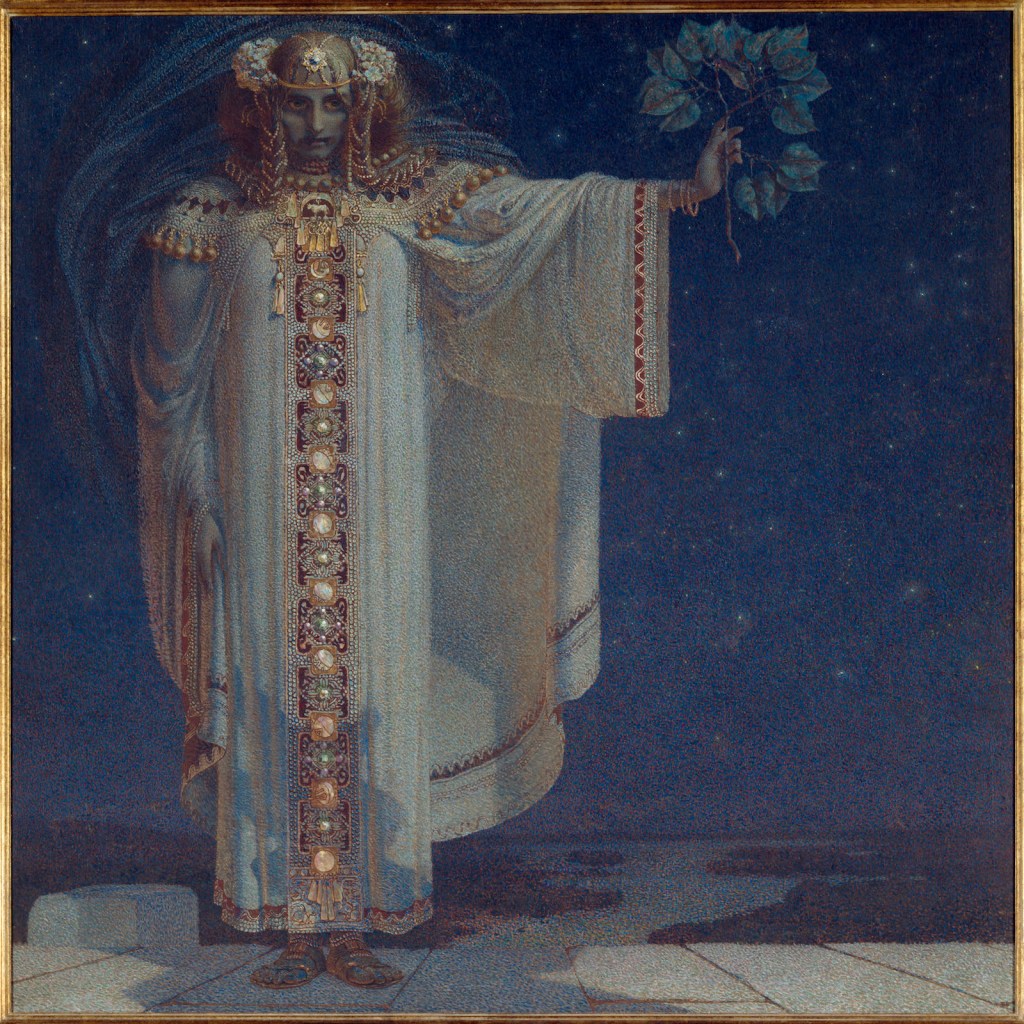
Here one finds Marc Chagall’s mystical take on the Prophet Isaiah, seer to the kings of Judah, Karel Masek’s stately moonlit version of the mythical Czech princess, the prophetess Libussa who predicted and founded the city of Prague alongside an anonymous soothsayer reading a book of necromancy with a black cat perched upon her shoulders by Clementine Dondey, a 19th century woman painter. Another reveals street performers and acrobats by Gustave Doré in which an owl figures in the foreground. Cats and owls are regarded as animals of magic and premonitions. Observing cat behavior to predict the weather goes all the way back to Antiquity and the Ancient Egyptians.

The exhibition explores the history of predictions and the pathway through the show is chronological in nature. The first prophets were heartily pre-occupied with predicting the end of the world like the Apocalypse of Saint John in the New Testament or upcoming political, cosmic and social upheaval. The bible is filled with predictions and six of its books are named for a prophet. During the Renaissance the world of Antiquity was all the rage and artists took an interest in depicting Greek and Roman soothsayers like Cassandra or Pythia, the high priestess of the Temple of Apollo in Delphi. The Sibyls, the famous women prophets of Rome were also a theme becoming Christianized in the Middle Ages. Angels, too , were regarded as messengers, visible in the paintings of the Annunciation with Mary and the archangel Gabriel.

Astrology and the zodiac were frequent themes through the ages along with card readers and fortune tellers arriving from eastern Europe. Fairies and seers from Celtic and Scandinavian mythologies were frequently represented as well. While in the 19th century artists themselves also predicted the future through their works especially the Symbolists and the Nabis which is a Hebrew and Arabic term meaning prophet and an art movement that believed that the artist had the power to reveal the invisible. The contemporary extension of the show includes modern representations of the zodiac and artistic interpretations of the Tarot cards, playing cards but with some sets custom-made for divination. The exhibition at the Monastère royal de Brou runs until June 23rd. At the H2M-Espace d’art contemporain until July 28th and is on at the Musée Thomas Henry from July 12th until October 16th. ©Trish Valicenti for The Gourmet Gazette.https://www.monastere-de-brou.fr/
Discover more from The Gourmet Gazette
Subscribe to get the latest posts sent to your email.
Categories: Gourmet Fair
 The Gourmet Gazette