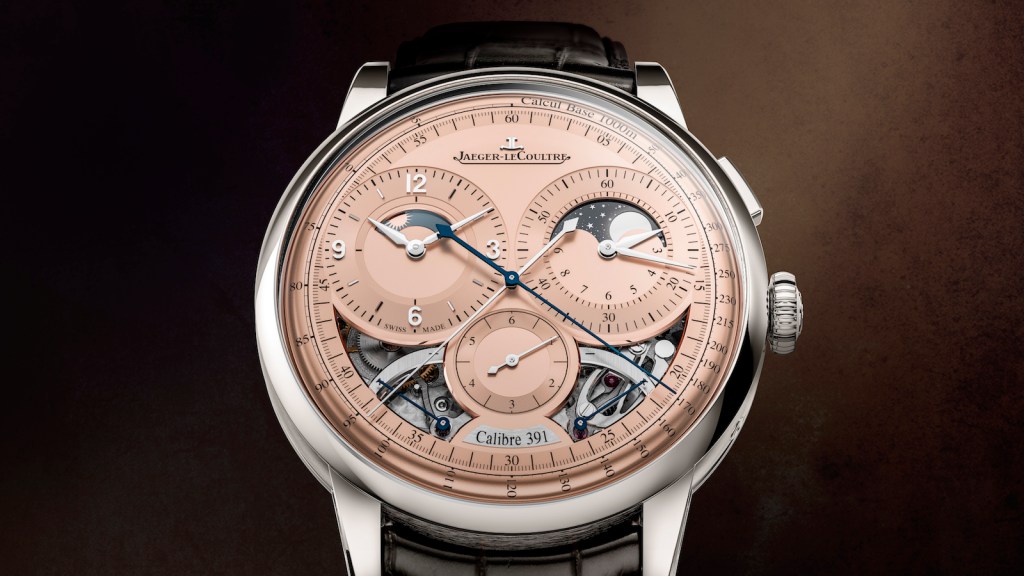
Geneva, Switzerland — In our ongoing coverage of the Watches and Wonders watch show we bring you a new wonder: Jaeger-LeCoultre’s The Duometre Chronograph Moon with the house’s new Calibre 391 which unites a highly complex chronograph with a moon phase display. The pateneted Duometre mechanism ensures remarkable precision while the new case and dials embody contemporary elegance and a distinctive style. The Duometre Chronograph Moon has been brought out in two versions: a 950 platinum case contrasting with a copper-colored dial, and an 18 carat pink gold case offset by a silver dial. Both models are enhanced by a hand-stitched alligator strap with small-scale alligator lining.
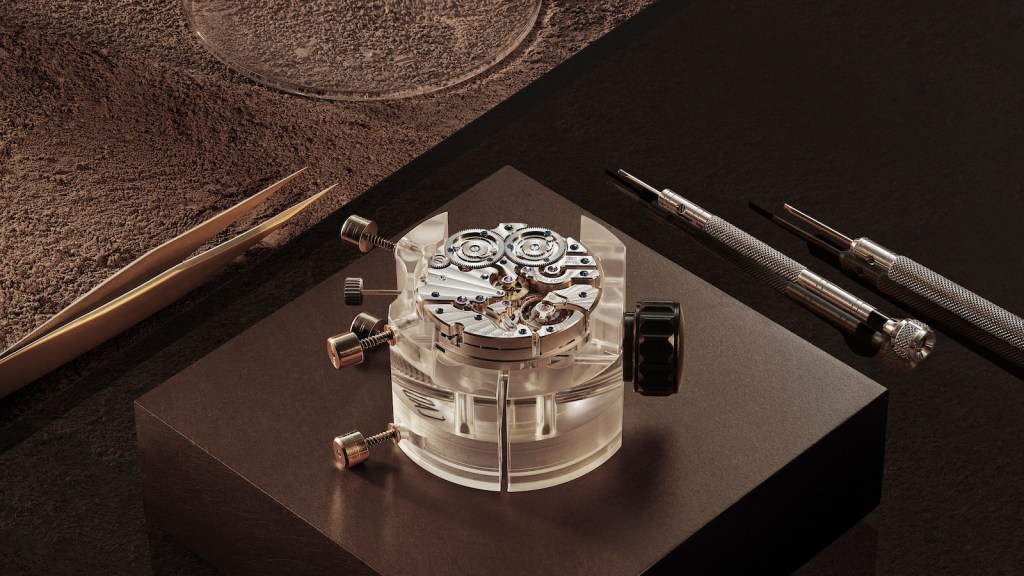
For Calibre 391, Jaeger-LeCoultre’s engineers started from the ground up to develop a fully integrated movement that combines a manually wound mono-pusher chronograph with moon phase and night-day complications, as well as two power reserve indicators and a seconde foudroyante (flying second) display. When the chronograph mechanism is activated, the foudroyante hand begins its whirling dance, making a complete rotation in one second, during which it beats six times – stopping instantaneously when the chronograph timer is stopped and thus providing a reading accurate to 1/6th of a second. On the dial side of the Duometre Chronograph Moon, two open-worked sections offer intriguing glimpses of the mechanism, hinting at the mechanical beauty of the calibre. On the reverse side, fully revealed beneath the transparent crystal case-back, much of the movement is open-worked. The open-working of Calibre 391 serves two purposes: it greatly enhance the aesthetics and it also serves a technical purpose, enabling the watchmakers to more easily assemble some parts of this highly complex calibre.

Traditional Haute Horlogerie finishes abound: crisply bevelled and polished angles define the edges of the bridges; brushed surfaces contrast with polished metal; perlage on the main plate reflects light back up through the mechanism; and blue screws provide a pleasing contrast to the silvery tones of the metal. The moon phase display is integrated into the chronograph hours and minutes sub-dial, which is set at 3 o’clock. Its blue background is visually balanced by that of the Night and Day display, which is integrated into the time sub-dial at 9 o’clock. Jaeger-LeCoultre has been distinguished by its mastery of complications and the precision of its mechanisms. Founded in 1833, Known as the Watchmaker of Watchmakers, the Manufacture has expressed its inventive spirit through the creation of more than 1,400 different calibres and the award of more than 430 patents. Special to The Gourmet Gazette. https://www.jaeger-lecoultre.com/us-en

Discover more from The Gourmet Gazette
Subscribe to get the latest posts sent to your email.
Categories: Gourmet Time Wear
 The Gourmet Gazette