
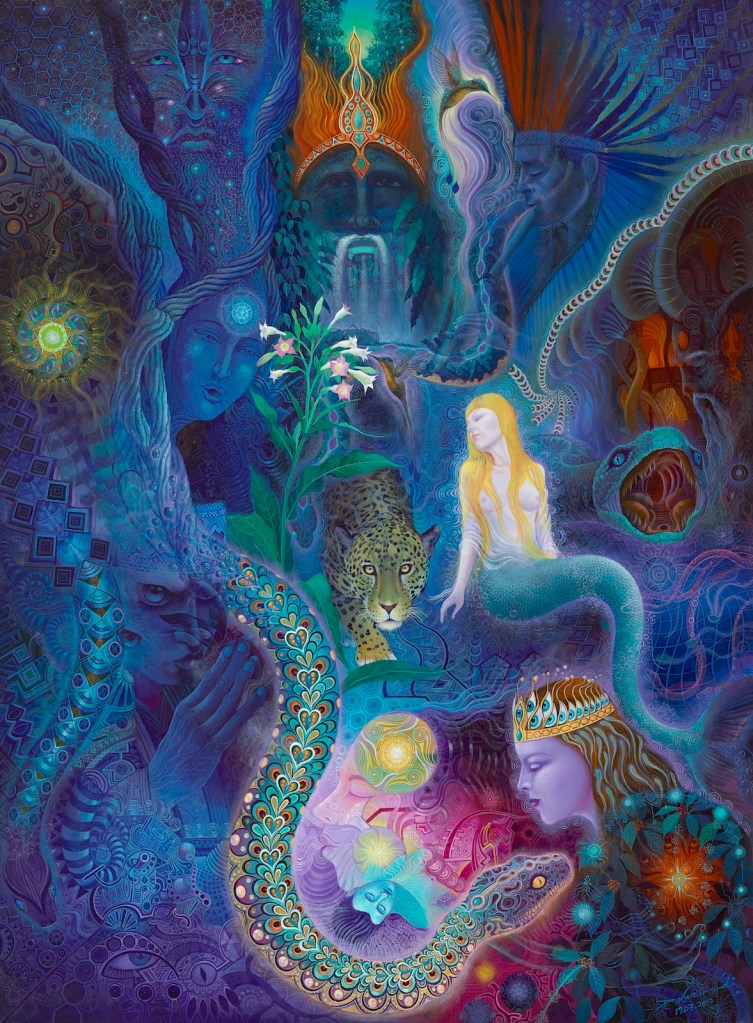
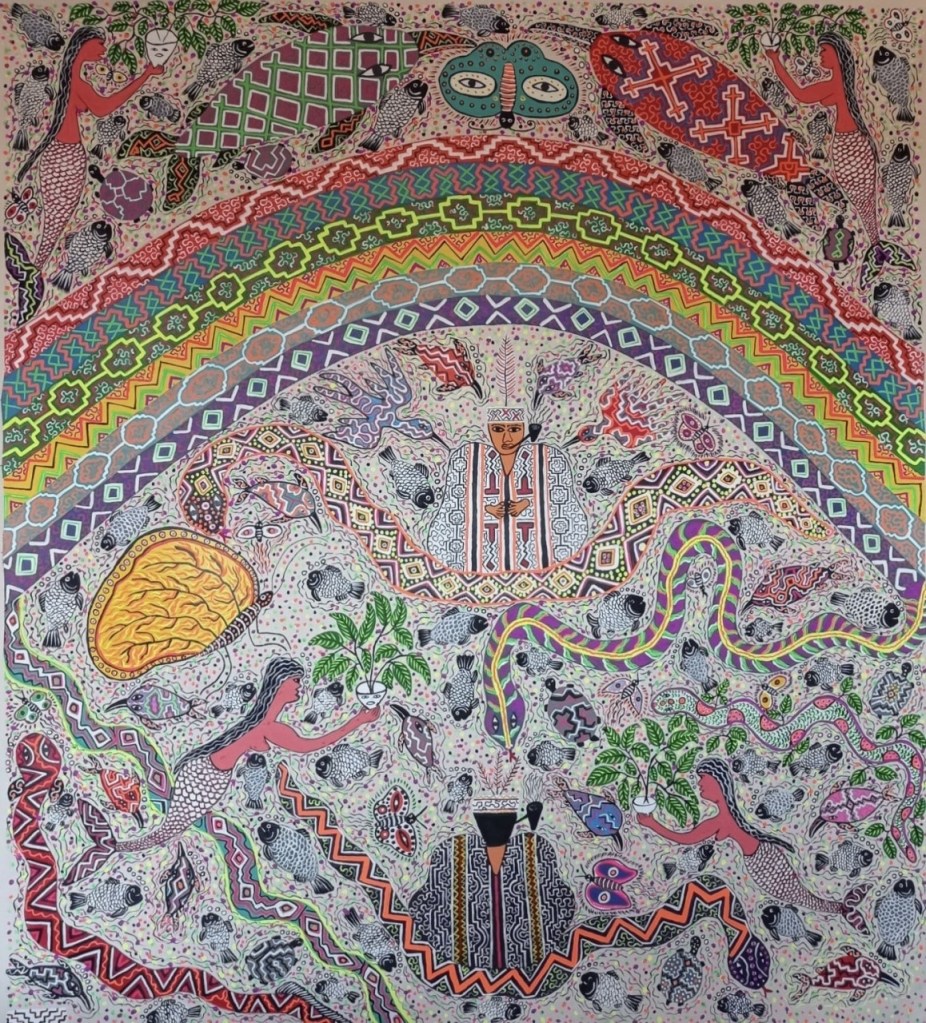
Paris, France — Snakes and mermaids, dragonflies and panthers. crowns of peacock feathers. A colorful and dream-filled exhibition is unfolding at the Musée du Quai Branly-Jacques Chirac in Paris. These are shamanistic visions floating seamlessly through what appears at times to be a sky, at times a sea. These are literally visionary paintings by the indigenous people of Peru’s Amazon as well as Western artists who create their art from the visions they had upon taking the hallucinogenic drink, ayahuasca, brewed from a local vine plant and which occupies a place of great importance in the tribes of the western Amazon. The exhibition, entitled Shamanic Visions, Ayahuasca Art in the Peruvian Amazon, explores the relationship between hallucinogenic images and the visual arts through the use of ayahuasca.
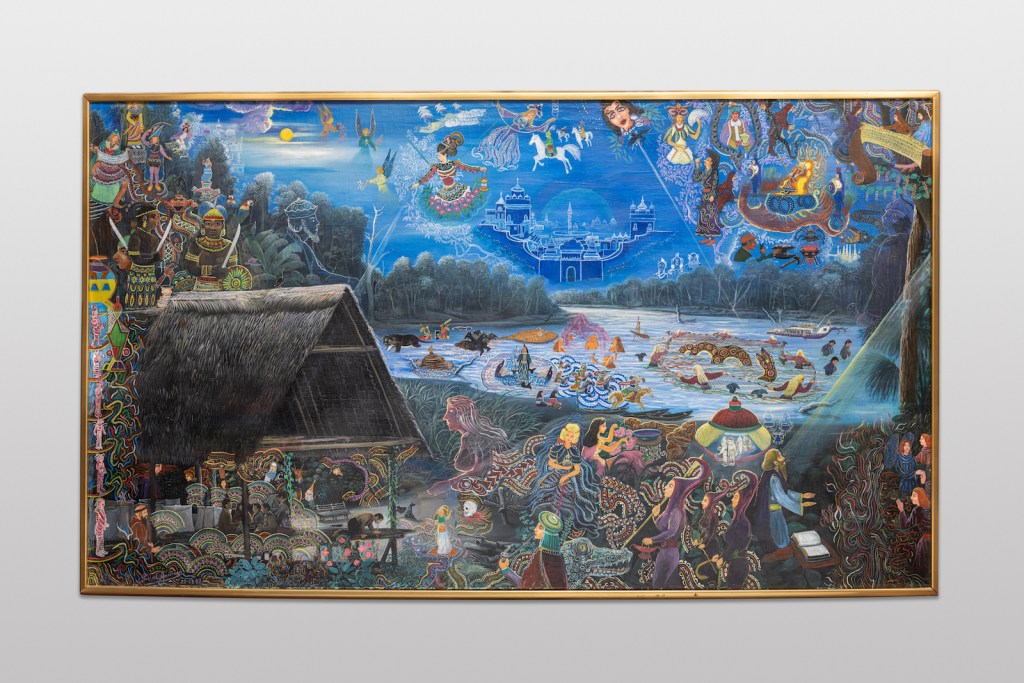
The word in the Quechua language literally mean vine of the dead and it has fascinated the Western world for over half a century since it was popularized by the Beat generation with shaman tourism currently being somewhat on-trend. It was traditionally ingested in shamanic rites for therapeutic or divination purposes but it is also a source of artistic creation for the visions it induces are regarded as a source of inspiration by indigenous artists in the Peruvian Amazon. The show brings together a selection of different ways in which these ayahuasca-induced images are represented today from the geometric works of the Shipibos-Konibos people, the writings of William S. Burroughs and Allen Ginsberg, paintings by Western artists under the influence and audio-visual productions.
Drinking ayahuasca is a tradition of some 150 indigenous peoples in the western Amazon within the context of shamanistic practices. It has also sparked, since the second half of the 20th century, an interest in the therapeutic properties of these psychedelics. The plant brew has provoked contrasting reactions around the world: while it is forbidden to consume it or sell it in France since 2005, the United States, within the strict context of a religious practice, has authorized its use since 2006. In Peru the knowledge of ayahuasca and its traditional use by the communities indigenous to the Amazon have been listed as Cultural Heritage of the Nation since 2008.

The works on display include the arts and crafts — ceramics and textiles — of the Shipibo-Konibo people who are indigenous to the Peruvian Amazon and extends into the incredible, magical realms of the visionary artists like the Peruvian Pablo Amaringo, a pioneer in the field and the spearhead of the visionary paintings of the Peruvian Amazon. He would establish, along with Luis Eduardo Luna, the Usko-Ayar Amazonian School of Painting. Sculptures from the Onanyati School are on exhibit as well. The school re-invents the visionary arts using wood as a medium. The Shamanic Vision exhibition is running until May 26th. ©Trish Valicenti for The Gourmet Gazette. https://www.quaibranly.fr/en/
Discover more from The Gourmet Gazette
Subscribe to get the latest posts sent to your email.
Categories: Gourmet Fair
 The Gourmet Gazette