
Utagawa Hiroshige (1797-1861) from a Series related to Genji. Edo Epoch, 1843-1847. Paris, musée Guimet, gift of Tadashi Goino, 2003, MA7318.©RMN-Grand Palais (Musée Guimet, Paris)/Michel Urtado. Photo courtesy Musée Guimet. Handout via The Gourmet Gazette
Paris, France — The Tale of Genji — regarded as the greatest work of Japanese literature and a great work of world literature and thought to be the world’s oldest full novel —captures the image of a unique society of highly refined and elegant Japanese aristocrats. It was written, circa 1000, by a woman Murasaki Shikibu, a Japanese writer, aristocrat and lady-in-waiting to the Imperial court of Japan during the Heian period, named for when the imperial capital was moved to Heian-kyo, today’s Kyoto. The court was largely dominated by the Fujiwara family of which Murasaki Shikibu was a member. Its translation by Arthur Waley is a classic of English literature.
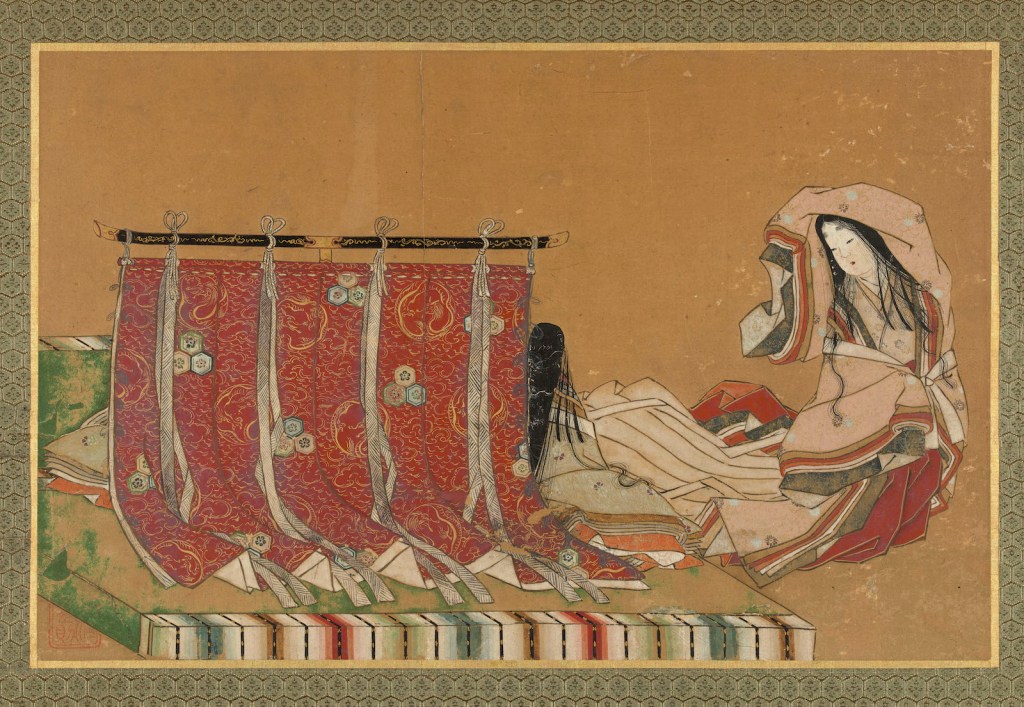
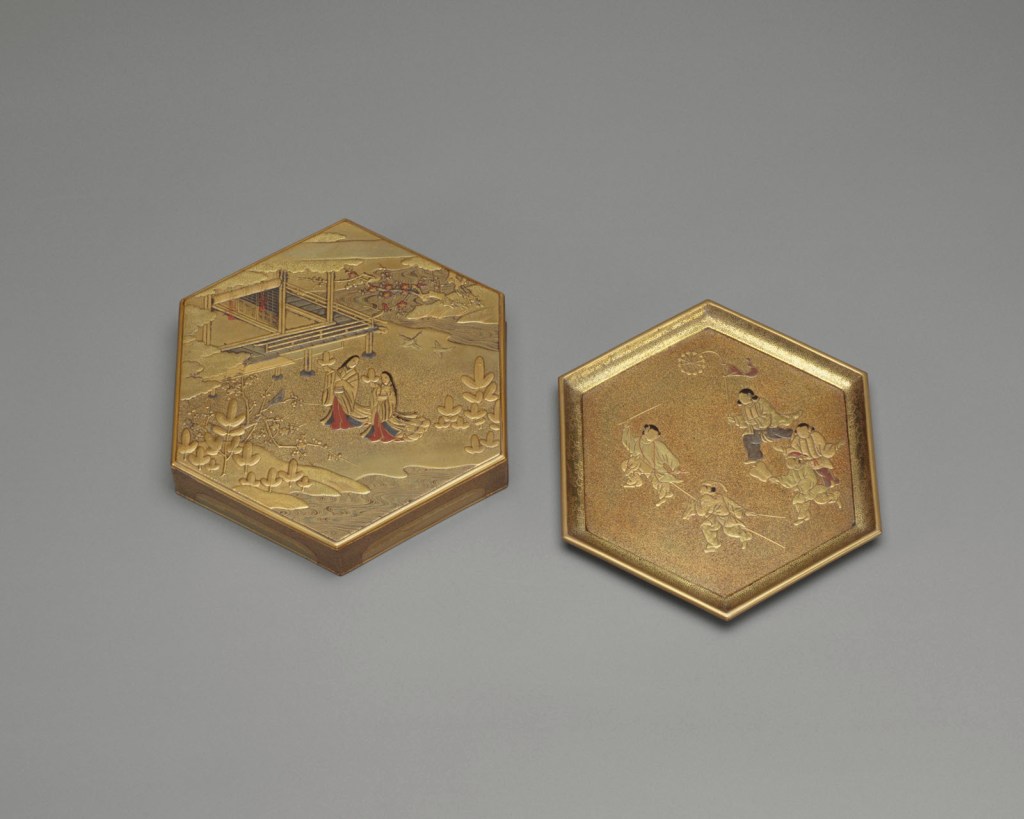
The Musée Guimet in Paris, France’s national museum devoted to the arts of Asia, is celebrating this world in an exhibition entitled At the Court of Prince Genji, a Thousand Years of Japanese Imagination. For the tale has generated an extremely rich iconography influencing even modern-day manga artists. Through the centuries it has inspired numerous Japanese artists and artisans working in myriad mediums including Itaro Yamaguchi (1901-2007), a master weaver from Kyoto, of whom four exceptional woven scrolls are being presented at the exhibition in their entirety for the first time. This pictorial art and creativity, inspired by the Imperial court of the time, which was an era of prolific artistic production, is on display with lacquerware, prints, textiles, kimonos, sculptures, paintings and precious objects from the Guimet Museum’s own collection as well as from other French and Japanese collections. Marie-Antoinette collected lacquerware and most of her collection is conserved at the Chateau of Versailles.
During the Heian period (794-1185) women enjoyed a great deal of freedom and it notably saw the emergence of women’s literature for the first time in the history of Japan. The women took possession of waka style poetry which they wrote using a cursive writing system developed from Chinese characters and transposed into the Japanese script of the era. They blended this waka poetry with prose creating a unique literary style. Murasaki Shikibu herself spoke Chinese, rare for the women of the age as it was reserved for the male elite.

The second part of the exhibition focuses on Itaro Yamaguchi (1901-2007), a master weaver from the Nishijin district of Kyoto, who wove and donated to the Guimet Museum four exquisite scrolls illustrating The Tale of Genji, representing the culmination of a lifetime dedicated to weaving. Based on painted scrolls from the Heian period, and created using a hybridized technique — Western mechanical Jacquard and its digital avatar — these four woven scrolls are being exhibited for the first time ever together and fully unrolled. They are presented with personal everyday objects, preparatory paintings and other woven creations by the artist.

This exhibition has been organized in partnership with the Sasakawa Foundation, a Franco-Japanese public-interest foundation, in celebration of thirty years of developing cultural relations and cooperation between France and Japan. Founded in 1889, the Guimet is devoted to the arts of Asia and presents the largest collection of Asian art in the world and Europe. The Genji exhibition is on until March 25th. ©Trish Valicenti for The Gourmet Gazette. 6 Pl. d’Iéna, 75116 Paris. Tel: + 33 (0)1 56 52 54 33. https://www.guimet.fr/fr

Discover more from The Gourmet Gazette
Subscribe to get the latest posts sent to your email.
Categories: Gourmet Fair
 The Gourmet Gazette
Outstanding 💯
LikeLike