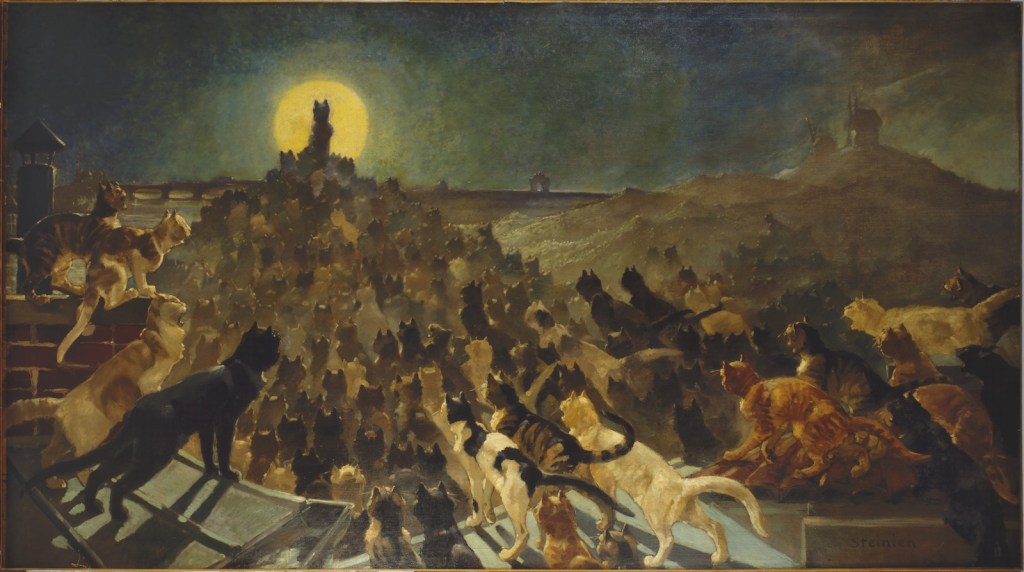
Paris, France — Long before they took over the internet, cats took over the heart and home of the Swiss artist Théophile-Alexandre Steinlen, a key figure in the artistic scene in Montmartre in Paris at the end of the 19th century. He would feed numerous neighborhood cats who would dwell in his home which was christened the Cat’s Cottage on Montmartre’s famed rue Caulaincourt. But he didn’t just have cats, he had pigeons, monkeys and a pet crocodile name Gustave that he would walk around the neighborhood streets to the delight and fright of the local residents. Montmartre and cats were synonymous with Bohemia and freedom. Although he is best known for his poster for the Black Cat Cabaret, he did not just paint cats, Steinlen’s subject of predilection was freedom. Draughtsman, engraver, painter and sculptor, Steinlen was a critical witness of his time, recording politics, protests and prostitutes in his works.
To mark the centenary of his death in 1923, the Musée de Montmartre is devoting an exhibition to this emblematic and singular artist of Montmartre. The show brings together a selection of one hundred works, including a large proportion of his oil paintings which are less known than his graphic works (namely the cat posters). The cats are all there of course including the compelling and rarely seen Apotheosis of the Cats, resembling a kind of feline mass centered around one lord-like black cat illuminated by a full moon. Steinlen’s figure of the cat was depicted as a symbol of freedom and an emblem of social outcasts.
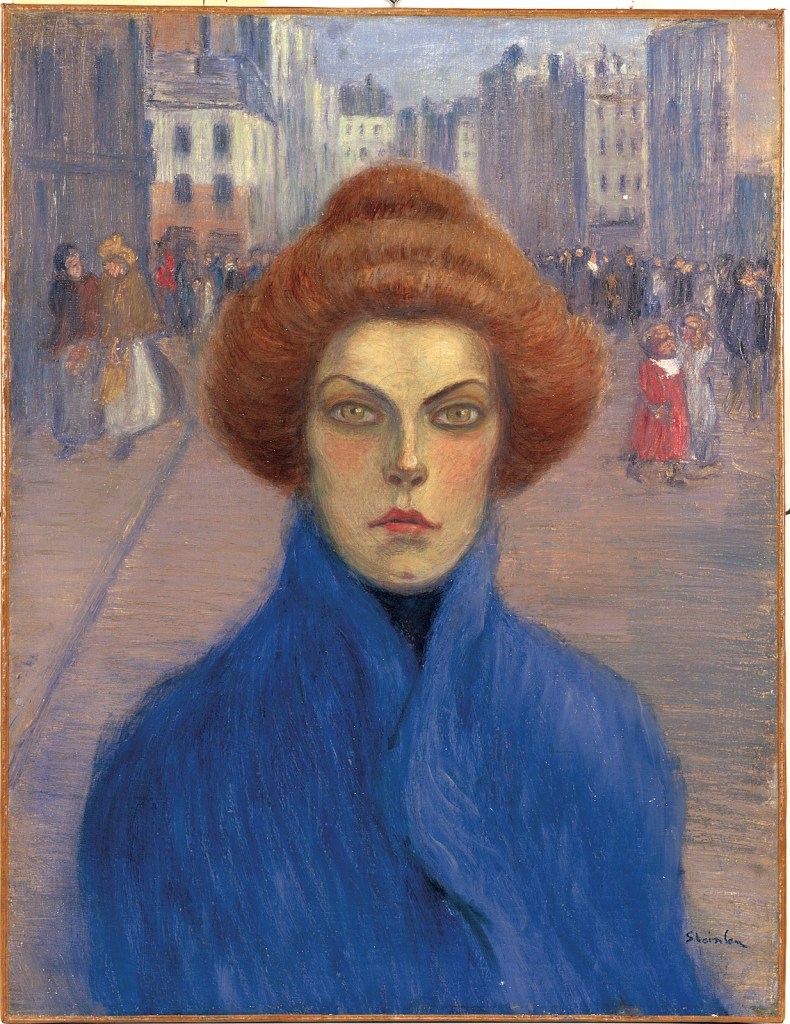
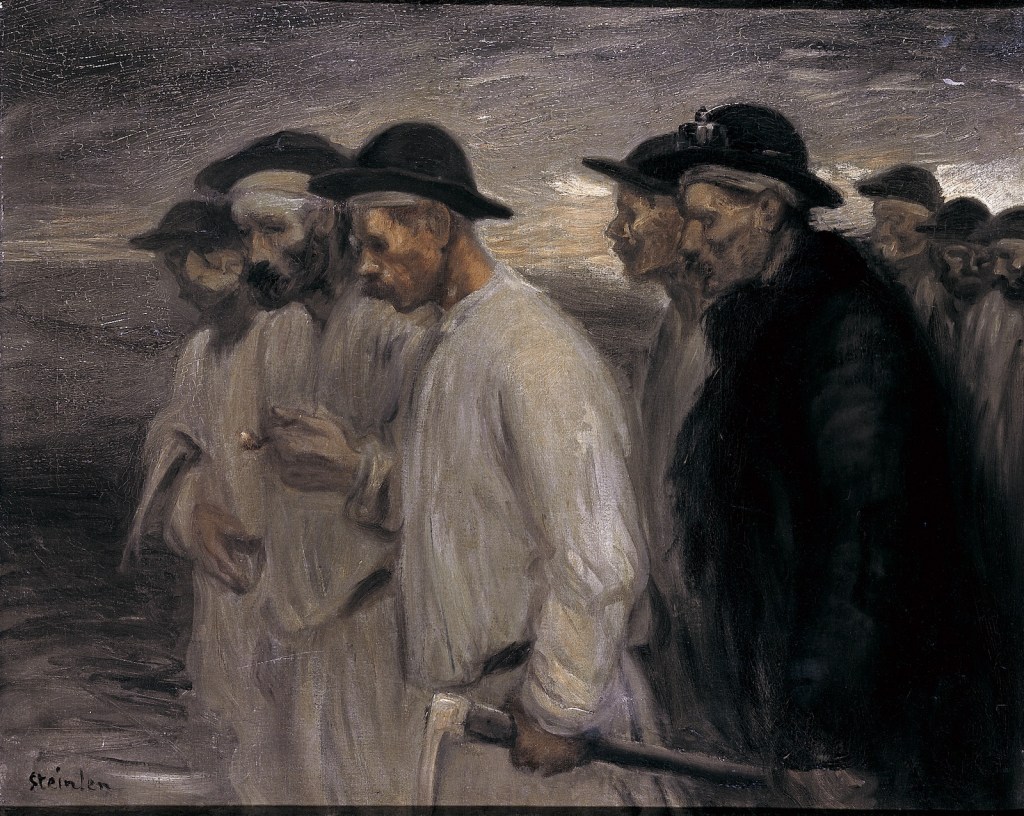
But his allegorical works and total commitment to opposing oppression are on hand as well with his paintings that illustrate the misery and suffering of myriad workers — peasants, miners, carters, coal sorters and prostitutes. He even visited the notorious Prison of Saint-Lazare where the prostitutes were held. A final group of paintings brings together his works that were inspired by the major academic genres: history, painting, landscapes and nudes. Steinlen lived through the Great War and he used pictorial and graphic means to represent the indescribable. The exhibition comprises works from the collections of the Société d’Histoire et d’Archéologie Le Vieux Montmartre and has benefitted from major institutional loans, in particular from the Musée d’Orsay, the Association des Amis du Petit Palais in Geneva, the Musée de Vernon, and prestigious private collections, including the David E. Weisman & Jacqueline E. Michel Collection.

The Musée de Montmartre is one of the Parisian capital’s most delightful museums housed in one of the oldest buildings on the Butte Montmartre, built in the 17th century. Surrounded by wonderful gardens replete with a delightful café that can all be visited, it was the place of creation for many artists like Auguste Renoir, Émile Bernard, Raoul Dufy, Charles Camoin, Suzanne Valadon and Maurice Utrillo. It is worth a visit for its permanent collections and the recreated apartment and artist’s studio of Suzanne Valadon who settled there in 1912 with her son and artist Maurice Utrillo. The Théophile-Alexandre Steinlen exhibition is on until February 11th. ©Trish Valicenti for The Gourmet Gazette. Musée de Montmartre Jardins Renoir, 12, rue Cortot, 75018 Paris +33 (0)1 49 25 89 39. Daily 10am to 6 pm. https://museedemontmartre.fr/en/
Discover more from The Gourmet Gazette
Subscribe to get the latest posts sent to your email.
Categories: Gourmet Fair
 The Gourmet Gazette